
Decision Guides
Private Suite vs. Big-Box Membership: Total Cost of Actually Getting Results
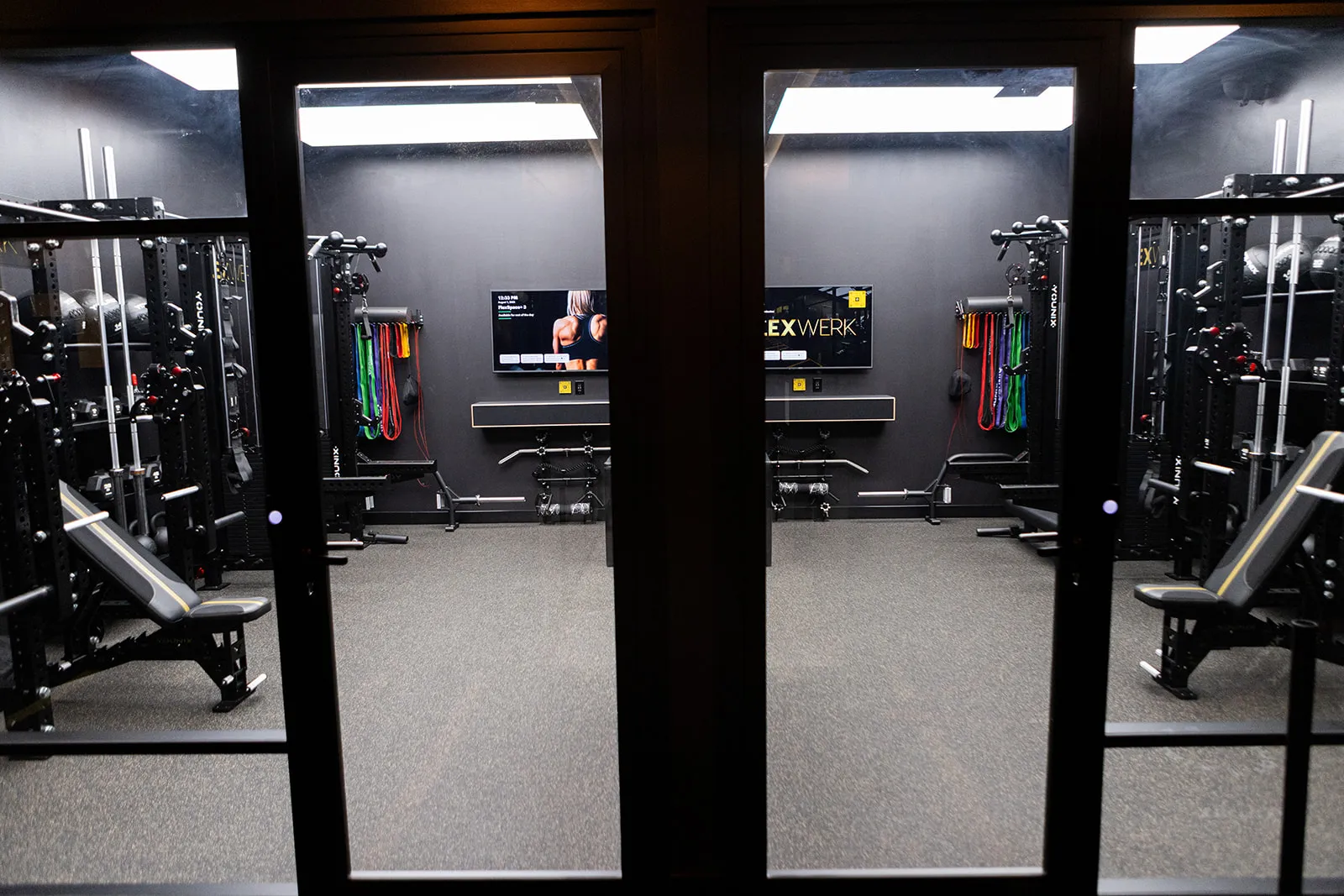
A big-box membership is cheaper to buy; coached training in a private suite is usually cheaper per result. That’s the entire comparison in one line, and it’s why the sticker prices mislead people. A membership card costs less per month than a single coached session — and pays for nothing unless you consistently show up knowing exactly what to do. Most people don’t buy access to equipment because they lack equipment. They buy it hoping it will turn into a changed body, and that conversion step is where the real costs live.
What each path actually costs in Carmel
Put the two paths side by side honestly and the gap narrows fast:
| Line item | Big-box path | Private-suite path |
|---|---|---|
| Facility access | Membership, commonly $10–60/month by tier | None — FlexWerk clients get free guest access through their coach |
| Coaching | $40–70/session, the typical Carmel big-box tier | $75–125+/session, the typical premium/private tier |
| Trainer’s share of your fee | Gyms commonly keep 40–60% | Your coach keeps 100% of what you pay |
Two things jump out. First, once you add real coaching to a big-box membership — and most people who succeed there do — you’re paying a membership plus sessions, and the monthly totals of the two paths start converging. Second, the private-suite number buys a categorically different product: an experienced independent coach, a fully equipped room that’s yours for the hour, and zero minutes lost to crowds or waiting.
The line item nobody shows you: the commission
When you pay for a session at a typical big-box gym, the trainer commonly keeps only 40–60% of it — the house takes the rest. That economic structure quietly shapes your experience. It pushes trainers toward volume and upsells, it makes the best coaches leave for independence as soon as they can, and it means the person you bonded with in March may be gone by June.
The private-suite model inverts this. At FlexWerk, coaches rent their suite time and keep everything they charge — so the people training there are established professionals running their own businesses, and their financial incentive is your long-term results, because retention is their revenue. Same dollars from your pocket; very different destination and very different incentives.
The cost that actually dominates: attendance
Here’s the uncomfortable math no pricing table captures: an unused membership has an infinite cost per workout. The fitness industry’s open secret is that big-box economics depend on members who pay and don’t come — the treadmills couldn’t physically hold everyone otherwise.
Coached training attacks exactly this failure mode. An appointment with a person who knows your name, your numbers, and your goals gets kept at a rate a keycard never will. That’s the honest answer to whether a personal trainer is worth it: you’re not paying for supervised exercise, you’re paying for the consistency that produces results. Cost per month favors the big box. Cost per result very often doesn’t.
There’s a time ledger running alongside the money ledger, too. A peak-hour big-box workout absorbs commute, check-in shuffle, waiting for equipment, and the improvisation tax of rebuilding your plan around whoever got to the rack first — an hour of training that costs ninety minutes of life. A private-suite session is the inverse: the room is reserved, the equipment is standing by, and the hour is wall-to-wall work. For the professionals who make up much of FlexWerk’s clientele, that recovered half hour, twice a week, is worth real money on its own.
When the big box genuinely wins
Credit where due — the big-box membership is the right buy if:
- You can program for yourself. You know progression, you lift with sound form, and you’d be paying a coach to count reps you’d have done anyway.
- You reliably attend without accountability. Some people do. If you’ve proven it across seasons, cheap access is a genuinely great product.
- Breadth is the point. Pools, courts, classes, and endless machine variety are big-box strengths a private suite doesn’t pretend to match.
- Budget is the binding constraint. A membership you use beats coaching you can’t sustain.
There’s also a legitimate hybrid: learn with a coach for a season, then take the program to a cheaper floor. Good coaches consider that a graduation, not a loss. The reverse migration is just as common, for what it’s worth — a year of solo big-box drift often becomes the reason someone finally prices out coaching, with the unused months serving as tuition.
How to run your own numbers
Total up what each path would cost you per month, then divide by honest expected attendance — not aspirational attendance, the real number your last twelve months would predict. A worked example makes the shape of it clear: a mid-tier membership plus two big-box training sessions a week lands in the same monthly neighborhood as two private-suite sessions with no membership at all — the paths converge far sooner than the sticker prices suggest. Factor in how pricing structures change the math too; how training packages work covers the models and their fine print.
Then price the thing sticker prices can’t show: what a year of actually-kept appointments would be worth to you. If the answer is “a lot,” the cheapest possible test of the private-suite path is a free consultation — a conversation, a body-composition baseline, and a free first session before a single dollar changes hands.
Related questions
Do I need a membership to train at FlexWerk?
No. Clients of FlexWerk trainers receive free guest access — you pay your coach for coaching, and there's no facility membership stacked on top of it.
Why does private-suite coaching cost more per session?
You're paying for an experienced independent coach and a fully equipped private room, and your coach keeps what you pay instead of surrendering a large commission to a gym.
Is a cheap big-box membership ever the better deal?
Genuinely yes — if you know how to program your own training, enjoy going, and actually attend. Cheap access is a great product for self-sufficient exercisers.