
Goals
Training Safely With a History of Back Pain (Coach-Guided)
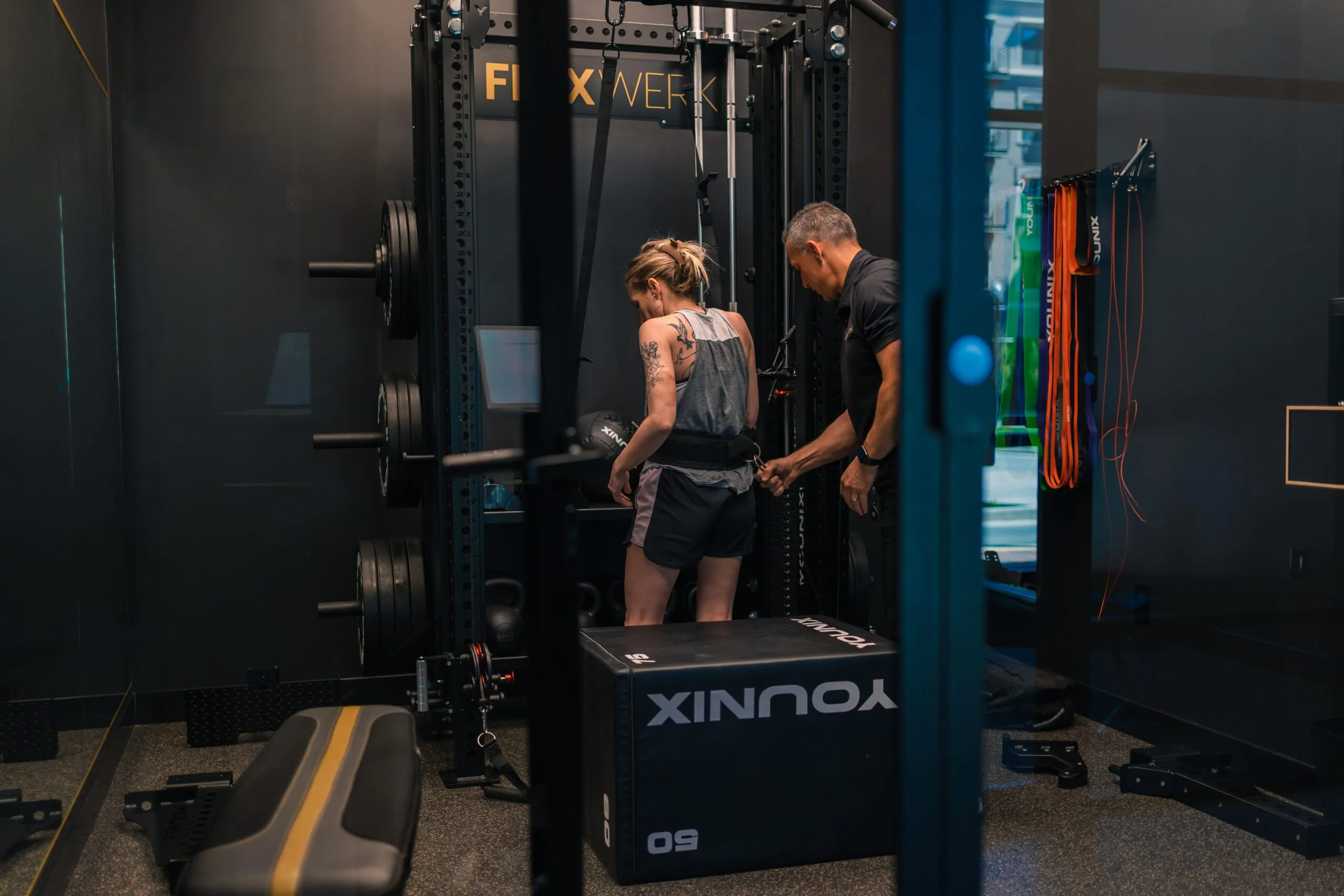
If your back has a history, every workout decision carries a second question: is this going to set it off? The coach-guided answer is neither bravado nor bubble wrap: once anything medical is cleared by your physician, gradual, well-coached strength training is how most people with a back-pain history rebuild both capacity and — just as important — confidence in their own spine.
Here’s how that works in practice, starting with who does what.
First, the scope line — because it protects you
Get the roles straight and everything else falls into place. Physicians and physical therapists own diagnosis and treatment: current pain, flare-ups, numbness or radiating symptoms, anything unexplained — that’s their lane, first and always. Trainers own what comes after clearance: building strength and capacity in a body whose medical questions are already answered. The distinction is spelled out further in trainer vs. physical therapist, and a coach who blurs it — diagnosing your disc, overriding your PT — is showing you the door you should use.
The handoff is where great outcomes happen: many people finish PT, get cleared, and then stall — afraid to load the rehab work into real-world strength. That gap between “cleared” and “confident” is precisely a coach’s territory, and it’s wide: people commonly sit in it for years, cleared on paper and cautious in practice, slowly deconditioning while waiting to feel ready.
Why avoiding lifting usually backfires
The instinct after back trouble is understandable: protect it, baby it, never pick up anything heavy again. But long-term avoidance tends to deliver the opposite of safety — muscles that would support the spine weaken from disuse, capacity shrinks, and everyday life becomes the heavy lifting you never trained for. The awkward grocery bag doesn’t care that you’ve been careful.
That’s why physicians so often point people with back histories toward appropriate exercise rather than away from it: within cleared limits, gradually building strength is broadly regarded as one of the most useful things people with back histories can do for how their backs handle daily life. The keyword is gradually — the failure mode isn’t lifting, it’s jumping to loads your current capacity hasn’t earned, which is also the classic mistake of restarting after years off.
What coach-guided training actually looks like
A back-aware program isn’t a special gadget routine — it’s ordinary good training with the progressions honored scrupulously:
- Full disclosure first. Your coach starts by learning your whole story — what happened, what treatment said, what movements worry you. Telling your trainer about the injury isn’t oversharing; it’s the raw material of the program.
- Hinge patterns, rebuilt from the ground up. Learning to move through the hips with a neutral, braced trunk — first unloaded, then supported variations, then progressively loaded as capacity proves itself.
- Bracing and breathing as skills. Creating trunk stiffness on demand is taught, practiced, and checked — it’s the difference between a spine that’s along for the ride and one that’s supported.
- Autoregulation. Some days your back feels great; some days it’s cranky. A live coach adjusts today’s session to today’s back — the thing no PDF program can do.
- Bright red lines. Sharp, radiating, or persistent pain stops the movement and prompts a physician check-in. Effort discomfort and warning pain are different signals, and learning to tell them apart is part of the coaching.
Why the private-suite setting earns its keep here
Training with a back history has a psychology problem gyms make worse. On a crowded floor, there’s quiet pressure to load faster than you should, and hesitating over a light kettlebell feels conspicuous. Ego loading is precisely the risk your history can’t afford.
In a private FlexWerk suite, that pressure doesn’t exist. It’s you, your coach, and a room with a full rack, cables, and dumbbells — light loads carry no embarrassment, tempo stays deliberate, and every rep gets watched by the one person whose only agenda is your progression. Sessions can even be filmed on the suite’s setup so you and your coach review your hinge mechanics together — feedback that matters more when precision is the program.
The honest arc
Expect the start to feel conservative — that’s design, not doubt. Capacity and confidence rebuild together over months: movements graduate, loads climb on evidence rather than hope, and somewhere along the way you notice you stopped bracing for disaster every time you pick something up. That change — trusting your back again — is the quiet headline result.
Plan for imperfection too. Backs with histories sometimes have opinions — a cranky week after bad sleep, a twinge from yard work that had nothing to do with training. A coached program absorbs these instead of collapsing: sessions get modified, loading steps back a rung, and anything that looks like more than ordinary crankiness — or any of the red-flag symptoms — goes to your physician before training resumes. The old pattern was flare-up, fear, quit, decondition, repeat. The new pattern is flare-up, adjust, continue — and the continuing is what keeps the long arc pointed up.
If your physician has cleared you and the gap between “cleared” and “confident” is where you’re stuck, a free consultation is the right-sized first step: your full history heard, a baseline set, and a program built carefully for the back you actually have — not the one a template assumes.
Related questions
Should I see a doctor or physical therapist before training with a back history?
If you have current pain, recent flare-ups, or an undiagnosed issue, yes — physician or PT first, coach second. If your history is older, resolved, and cleared, a trainer can program around it from day one; when in doubt, ask your physician.
Will my trainer have me deadlift with a bad back history?
Possibly, eventually, and only by earning it — hinge patterns are typically rebuilt gradually from supported variations toward loaded ones as your capacity and confidence grow. Nothing is mandatory; movements are selected for your body, not a template.
What should I do if something hurts during a session?
Say so immediately — a good coach adjusts or stops the movement on the spot, and pain that's sharp, radiating, or persistent is a signal to check in with your physician before continuing. Discomfort from effort and pain from a problem are different things, and you never push through the second.