
Local & Comparison
Is There 1-on-1 Training Near Fishers?
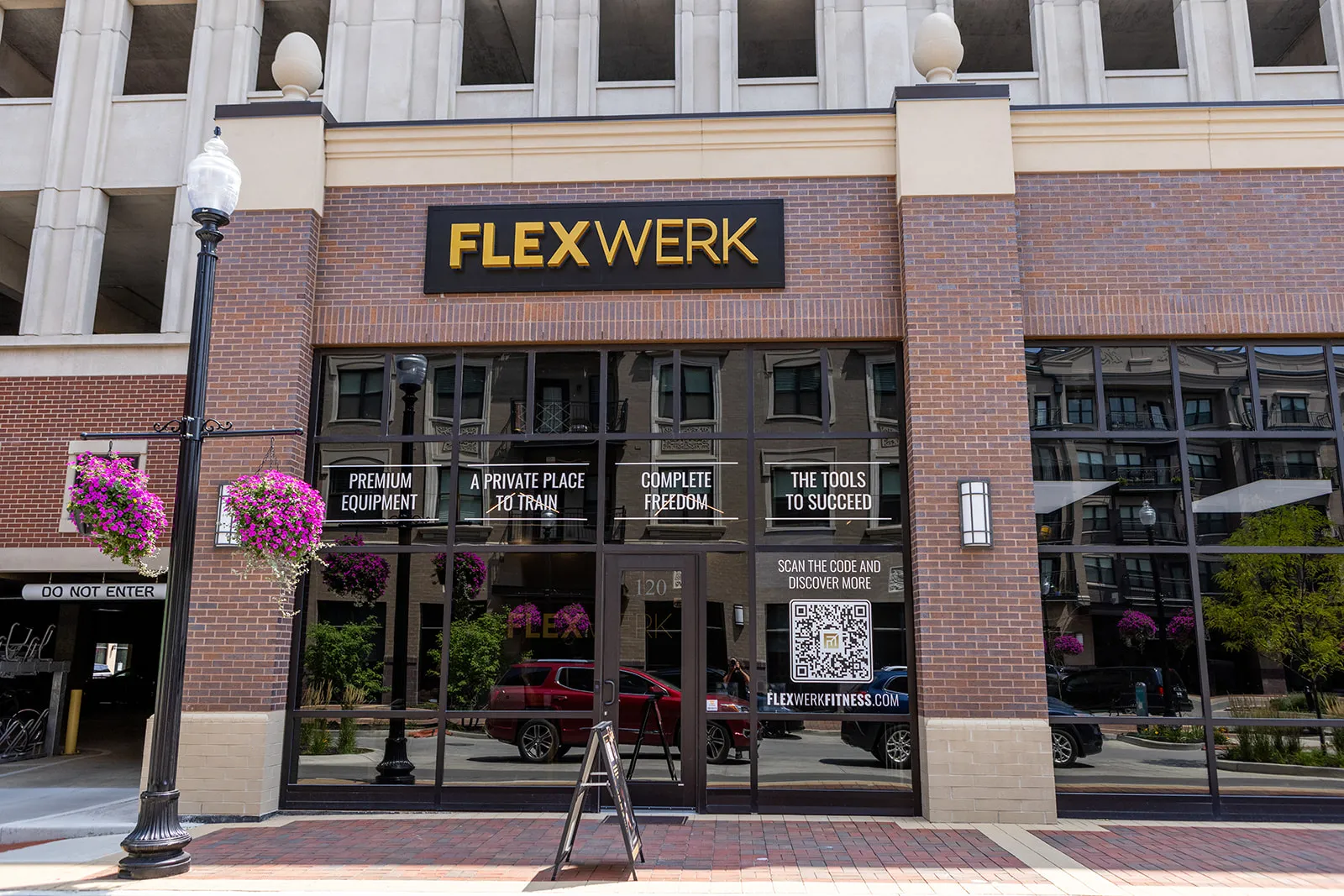
Yes — Fishers has real 1-on-1 training options, but if you want true one-on-one — a private room, not just a dedicated trainer on a shared floor — the closest facility built entirely around that is FlexWerk at Carmel City Center, west along the 146th Street corridor. The distinction between those two versions of “1-on-1” is the whole decision, so let’s start there.
“1-on-1” means two different things
Every personal trainer sells 1-on-1 attention. Almost none of them can sell you a 1-on-1 environment. At a typical gym, your dedicated coach programs your session and counts your reps — while you share the floor with everyone else’s workout: waiting for the squat rack, dodging the circuit class, performing your worst push-up next to someone’s best deadlift.
For plenty of people, that’s fine. But if you’ve ever cut a set short because someone was hovering, skipped an exercise because the station was taken, or — most common — avoided the gym entirely because you didn’t want an audience while you’re out of shape, then the environment is the product. True one-on-one means the room itself is yours: your coach, your equipment, your music, a door.
The distinction also changes what a session can contain. With the room reserved, a coach can build circuits across stations without losing them, film your lifts for form review without bystanders in frame, and run the hour to a plan instead of improvising around traffic. The same trainer is simply more effective when the environment stops negotiating with them.
What 1-on-1 looks like in and around Fishers
Close to home, Fishers offers the standard menu: trainers at the big-box gyms (typically $40–70/hour at that tier), boutique and semi-private studios where a coach splits attention across a few clients, and in-home trainers who bring the session to your garage. Premium and private-tier coaching around the northern suburbs commonly runs $75–125+ per hour. The general guide to trainers near Fishers covers the local landscape in more depth.
Each local option maps to a specific person. The big-box trainer suits you if the shared floor genuinely doesn’t bother you and price matters most. Semi-private suits you if you like a bit of company and don’t need programming built entirely around your body. In-home suits the convenience-first season of life — with the honest caveat that your program is capped by whatever equipment fits in the garage, which becomes a real ceiling once progressive strength work gets going.
What Fishers doesn’t currently have in the same form is the fully private suite model — which is where the drive west comes in.
The private-suite option: FlexWerk at Carmel City Center
FlexWerk is built exclusively around private training rooms. Your session happens inside a FlexSpace — 150 square feet with a custom lifting rack, cable system, and dumbbells supporting 850+ exercises in the Standard, or 230 square feet supporting 1,100+ exercises in the Plus, with dedicated cardio suites running HYDROW rowers, CLMBR machines, and curved treadmills. Every room has WiFi, music streaming, a TV, and controllable lighting.
Just as important as the room is how you find the coach: FlexConnect matches you from among the 40+ independent fitness professionals working there, based on your goals, schedule, personality, and their specialties — rather than whoever has an open slot. The coaching itself runs on a measured, phased system — Reset, Build, Refine over a 30/60/90 arc — anchored to an InBody body-composition baseline rather than guesswork, so a Fishers commute buys you a program with checkpoints, not just a nicer room.
And the entry point is friendly: a free consultation with the InBody scan included, plus a free first session, before any money changes hands.
From most of Fishers, the trip runs straight across 146th Street toward Carmel City Center, steps from the Monon Trail, with garage parking a short walk away — a route most Fishers residents already drive for other reasons.
The honest trade-off: the drive
A cross-town drive twice a week is a real cost, and pretending otherwise would be bad advice. Two things decide whether it’s worth it.
First, schedule fit. FlexWerk is open 5 AM to 9 PM on weekdays and 7 AM to 4 PM on weekends, which means the drive can attach to a commute or an early morning rather than carving a hole in your day. A 5:45 AM session against empty roads is a very different proposition than fighting 146th Street at 5:30 PM.
Second, frequency. Most coached clients train two or three times a week — and twice a week is genuinely enough to progress when the sessions are programmed well. Two focused trips weekly is a sustainable pattern; the people who burn out on drives are usually the ones trying to commute daily to a big-box.
If neither pattern fits your life, choose a good Fishers-local option instead — a nearby trainer you’ll actually see every week beats a better setup you’ll start skipping in March. Consistency is the variable that decides results; everything else on this page is just ways of protecting it.
How to decide from here
The test that settles it is experiential, not analytical: sit in one conversation, see one suite, and check the drive against your real schedule on the way home. FlexWerk’s free consultation costs you one trip and nothing else — you leave with a body-composition baseline and a clear yes-or-no feeling about whether true one-on-one, at that distance, is your answer.
Related questions
How long is the drive from Fishers to FlexWerk?
Carmel City Center sits west of Fishers along the 146th Street corridor — for most of Fishers it's a manageable cross-town drive, with garage parking a short walk from the door.
Is 1-on-1 training worth the premium over group classes?
If you have a specific goal, an injury history, or you've plateaued, usually yes — programming built for your body beats a workout built for a room. If group energy is what keeps you consistent, classes are a fine answer.
Can my partner and I train together?
Yes — a FlexSpace Standard fits one or two guests, and the larger FlexSpace Plus takes up to five, which is how couples and small-group sessions typically run.