
Audiences
Gym Anxiety Is Real: What Training in a Private Room Changes
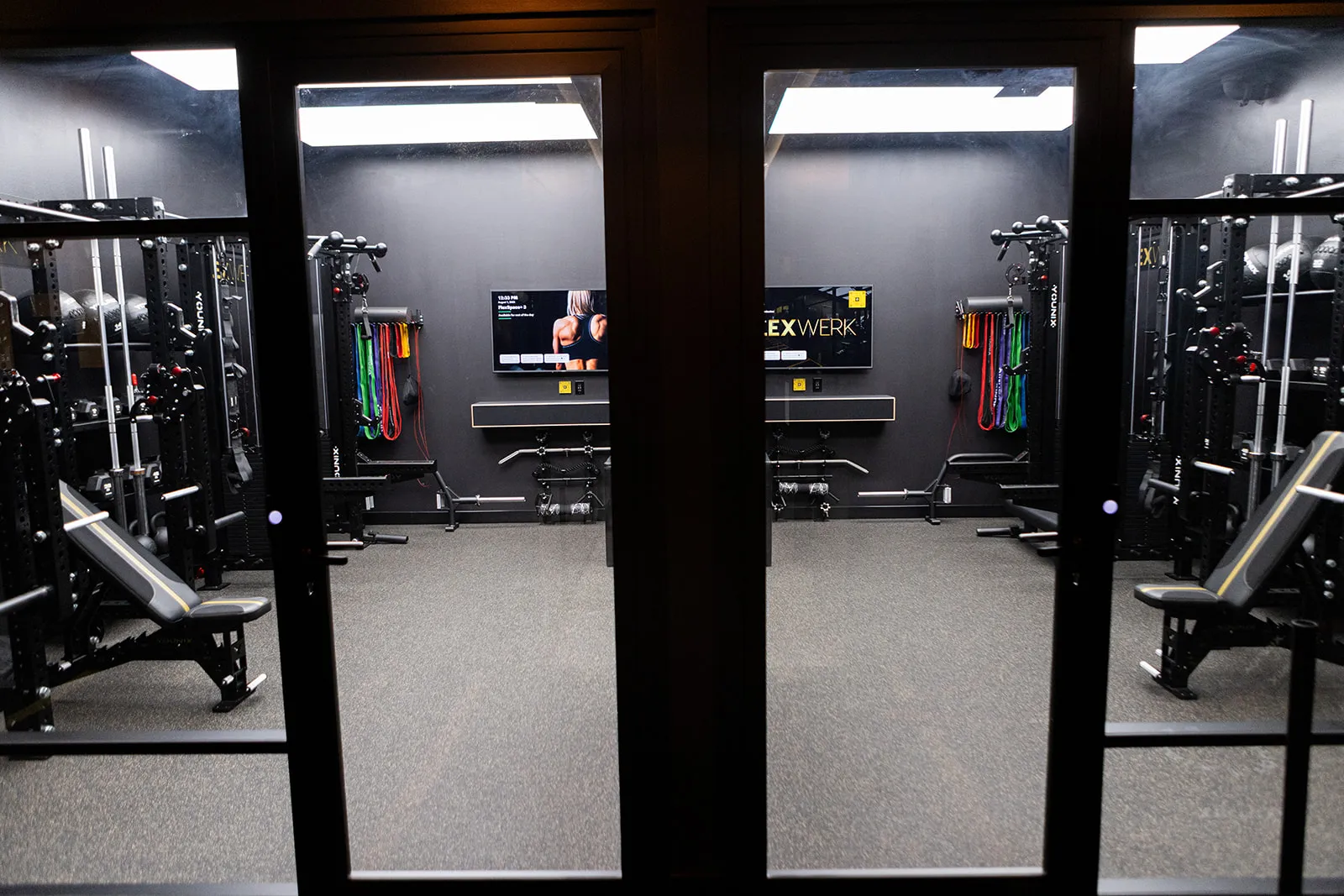
If the thought of a crowded gym floor keeps you from training, you’re not fragile — you’re responding normally to an environment that puts beginners on display. Gym anxiety is one of the most common reasons people never start or quietly quit, and training in a private room with one coach removes its actual cause — the audience — rather than asking you to grit your way past it.
Here’s what changes, mechanically, when the room belongs to you.
Gym anxiety is a design response, not a weakness
Consider what a commercial gym asks of a newcomer: perform an unfamiliar physical skill, in public, surrounded by people who appear expert, in clothing you’re not sure about, with equipment you don’t fully understand, while assuming everyone can see all of it. Almost no other skill is learned under those conditions. We don’t teach piano in the middle of a concert.
So people respond rationally. They hover on the treadmill because it’s the machine that requires no decisions. They come at odd hours, keep headphones in as armor, skip the free-weight area entirely — or they stop coming, and the membership becomes a monthly donation. None of this is a motivation problem. It’s an environment problem wearing a motivation costume.
What a private room structurally removes
Training inside a private suite doesn’t manage the anxiety — it deletes its inputs:
- No audience. The fear of being watched can’t fire when there’s no one to watch. At FlexWerk, your session runs in your own suite — an enclosed room with its own rack, cables, and dumbbells, not a curtained corner of a shared floor.
- No comparison. No one lifting triple your weight in your peripheral vision, recalibrating what “beginner” feels like every thirty seconds.
- No equipment stand-offs. Nothing to wait for, no one waiting on you, no wondering whether you’re allowed to be somewhere.
- Your atmosphere. Music you choose, lighting you control — details that sound cosmetic until you realize how much of gym dread is sensory.
What remains is the useful part of a gym — equipment, structure, effort — with the performance layer stripped out.
The one-person audience you actually want
Here’s the nuance that separates private coaching from simply training alone: one person is watching you, and that turns out to be the fix rather than the fear. A coach’s attention is categorically different from a crowd’s — it’s expert, contracted, and pointed entirely at helping you. Nobody in a coach’s suite wonders if they’re being judged, because the judgments are the service: move your hips back, breathe here, that was better than last week.
For anxious beginners this matters doubly, because anxiety usually travels with uncertainty — am I doing this right? is this dangerous? is this normal? A coach answers those questions in real time, which drains the uncertainty that feeds the anxiety. Getting matched with the right personality matters here too: patient teacher, quiet encourager, or upbeat energy — the fit is part of the treatment.
Confidence that transfers
The fair challenge to private training: aren’t you just hiding? The honest answer is no — hiding is what the anxiety was already causing. Skill-building in a low-threat environment is how humans learn everything difficult, and the confidence it produces is portable. After months of coached training, you know how to lift, what weights feel like, what you’re capable of — and people who build that competence privately routinely find that gym floors simply stop being threatening, because the uncertainty that made them threatening is gone.
And if you never want a commercial gym again? Also fine. Private-suite training is a complete answer, not a stepping stone you’re obligated to graduate from. Plenty of experienced lifters choose it purely for the focus and equipment access, no anxiety involved.
Starting without a spotlight
The lowest-stakes first step is built for exactly this: a free consultation at FlexWerk is a conversation and an InBody body-composition scan — not a workout, not a test, nothing to perform. You’ll see the suites, meet the environment, and leave with a baseline and a plan whether or not you continue. Weekday hours run 5 AM to 9 PM, so even the quiet-hours instinct is accommodated — except here, every hour is the quiet hour.
It’s worth knowing what early sessions feel like, because anxious minds fill unknowns with worst cases. The first ones are conversational and deliberately unintimidating: your coach teaches basic movements at easy loads, asks questions, adjusts, and builds from wherever you actually are — there’s no fitness bar to clear and no test to fail. Most people report the same arc: the dread peaks in the parking lot of session one, drops sharply by session three, and somewhere around the second month they notice the strange new fact that they look forward to training. That’s not a personality transplant. It’s what happens when the threat is removed and the competence starts compounding.
And tell your coach about the anxiety directly — it’s common, they’ve coached it before, and naming it lets them pace the early weeks accordingly. A coach who knows you’re nervous about free weights introduces them differently than one who doesn’t.
If the gym has been the obstacle between you and training — for months or for decades — take the gym out of the equation and see what’s left. Usually what’s left is just you, a coach, and progress that was never actually out of reach.
Related questions
Is gym anxiety common or is it just me?
It's one of the most commonly cited reasons people avoid gyms or quit within weeks of joining — feeling watched, feeling judged, or not knowing what to do in front of strangers. It's a normal response to a genuinely exposed environment, not a personal flaw.
Isn't private training just avoiding the problem?
No — avoidance is staying home. Private training removes the audience so you can build skill and strength, and the confidence that comes from real competence transfers everywhere, including into any gym you ever choose to walk into later.
Will anyone else see me train at FlexWerk?
Your session happens in your own suite with your coach — no shared gym floor, no walk-through traffic, no waiting for equipment among strangers. The room, the music, and the lighting are set for you.