
Getting Started
How Fit Do I Need to Be to Start With a Trainer?
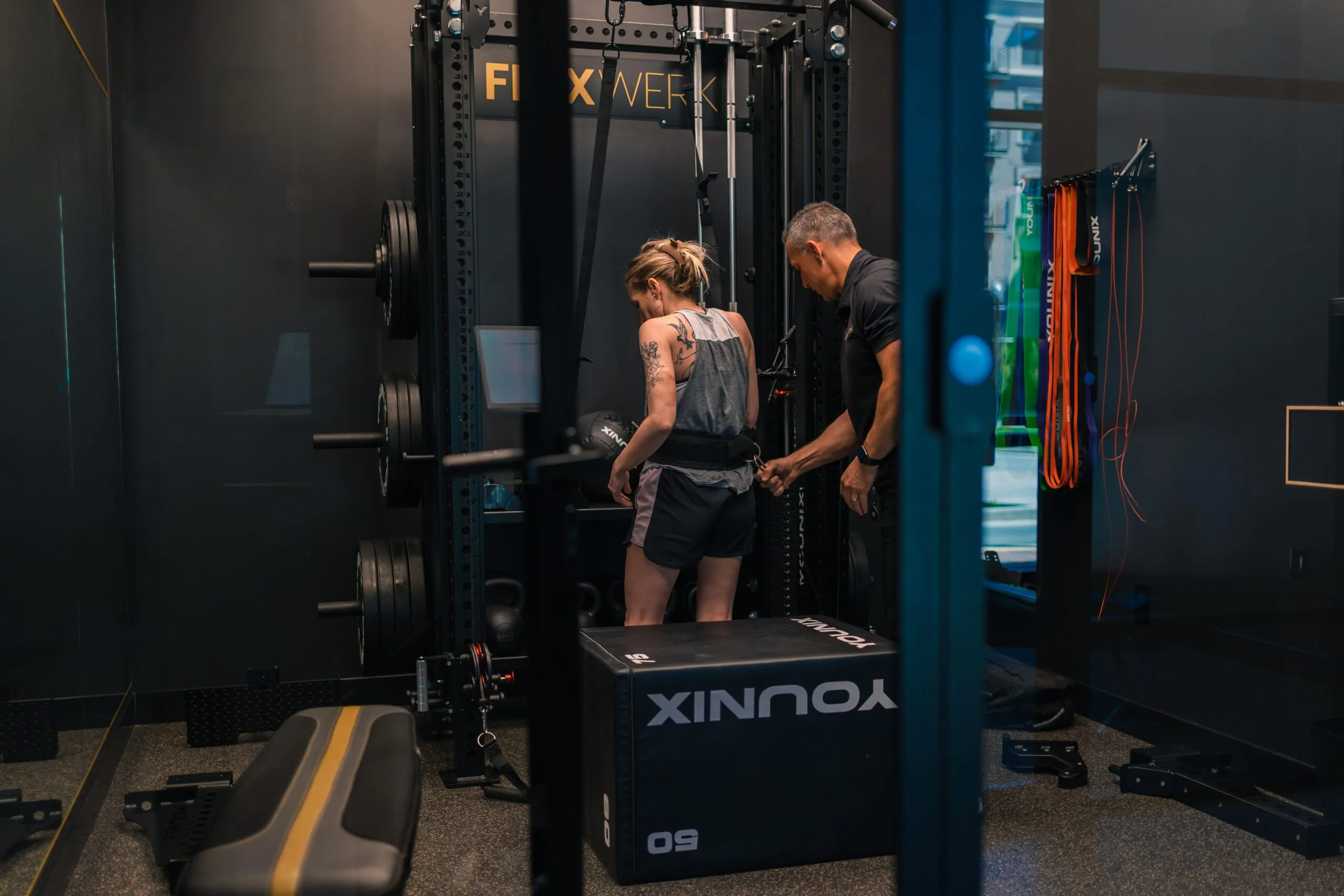
You don’t need to be fit at all to start with a trainer — “not fit yet” is the entire reason the profession exists. A coach’s job is to build the program from wherever you actually are: the loads scale down as far as they need to, the movements modify to fit your body, and the first weeks are designed around your current capacity, not some entry standard. The belief that you should “get in shape first” is the single most effective idea ever invented for keeping people out of shape.
“Get fit first, then hire a coach” is exactly backwards
Nobody cleans the house before the cleaner comes — yet people routinely spend months trying to self-train up to some imagined minimum before letting a professional help. Look at what the logic actually claims: that you should do the hardest part (starting from zero, alone, without knowledge or accountability) unassisted, and only bring in expert help once the hard part is done. Reverse it and it makes sense. The beginning is when a coach changes the most — when technique habits form, when the injury risk of guessing is highest, when motivation is most fragile, and when smart programming produces the fastest visible wins. Beginners are not an awkward edge case of personal training; they are its center of gravity. If you can walk into a room and answer questions honestly, you meet the fitness requirement, because there isn’t one — a point covered from another angle in personal training for beginners.
What starting from zero actually looks like
The first weeks of a well-coached program are quieter than people fear. Expect a conversation and a baseline before anything else — goals, schedule, health history, and an InBody body-composition scan so progress gets measured against data rather than mirror-guessing. Then foundational work: learning to squat, hinge, push, pull, and carry with weights that feel almost suspiciously manageable. That restraint is the professionalism. Early strength gains come largely from your nervous system learning coordination, so light loads produce real progress while your joints and tissues adapt — and FlexWerk’s phased system formalizes it, opening with a Reset phase built around habits, movement quality, and baseline before Build turns up the intensity. The first session sets that tone deliberately: worked, not wrecked. A coach who destroys a beginner on day one isn’t proving the training works; they’re proving they don’t understand beginners. The suites themselves are built for that full range, too — a FlexSpace Standard packs 850+ exercises’ worth of equipment into one private room, which means your coach can scale a movement down or up on the spot without marching you across a gym floor to hunt for the next station.
The real barrier is the audience — and it’s removable
Press on “I’m not fit enough for a trainer” and it’s usually not about the trainer at all. It’s about the room: the fear of being the least fit person on a gym floor, watched by people who look like they were born there. That fear is worth taking seriously instead of dismissing — and worth solving structurally. At FlexWerk, sessions happen inside a private suite: an entire room with its own equipment, music, and lighting, shared with exactly two people — you and your coach. There is no floor to be seen on, no mirrors ringed by strangers, no regulars’ territory to navigate. The suite doesn’t make training easier; it makes starting easier, by deleting the part of the experience that was never about fitness in the first place. Whether that’s you or not, it explains a pattern coaches see constantly: the people who “aren’t ready for a gym” turn out to be perfectly ready to train — just not ready to perform in public while doing it. More on that dynamic in gym anxiety and private training.
The prerequisites that do exist (there are only three)
Honesty requires naming the real entry requirements, none of which involve fitness:
- Medical green light where it applies. Trainers screen your health history — typically with a PAR-Q — and if anything flags, the next stop is your physician for clearance, not a workaround. Coaches program inside your doctor’s guidance; they never replace it.
- A schedule that can hold two sessions a week. Not because more is forbidden, but because twice a week is the reliable floor where progress compounds. If your calendar can’t hold two hours, fix the calendar conversation first — a good coach will help.
- Willingness to tell the truth. About your history, your habits, and what you’ll actually do between sessions. Every honest answer improves the program; every flattering one degrades it.
Notice what’s absent: no strength standard, no weight requirement, no “athletic background,” no age cutoff. Three prerequisites, all attitudinal, all in your control this week.
Starting this week, from exactly where you are
The distance between “not fit enough” and “started” is one conversation. A free consultation at FlexWerk is built for people at the starting line: a no-obligation talk about your goals and history, a free InBody scan that turns “out of shape” into actual numbers a program can be built from, and a FlexConnect match with a coach suited to your goals, schedule, and personality — including coaches whose specialty is precisely people restarting from zero. You don’t need to be fit to sit in that chair. You need to show up as you are — which, inconveniently for every excuse, is the one qualification you already have.
Related questions
Will the first session be brutally hard?
No — a good first session is an assessment, deliberately submaximal. The coach's job on day one is to learn how you move and where your starting line is, not to flatten you as a demonstration.
What if I haven't exercised in ten years?
Then you're squarely in the population trainers build careers serving. A long layoff changes the starting loads and the pace of the first month — it doesn't change your eligibility to begin.
Do I need to lose weight before I start strength training?
No — for most people the two goals work best together, since strength work supports the muscle you want to keep while losing fat. Your coach programs for your current body, and your physician remains the stop for any medical concerns.