
Audiences
Strong After 50: Why Women in Carmel Are Lifting (Safely)
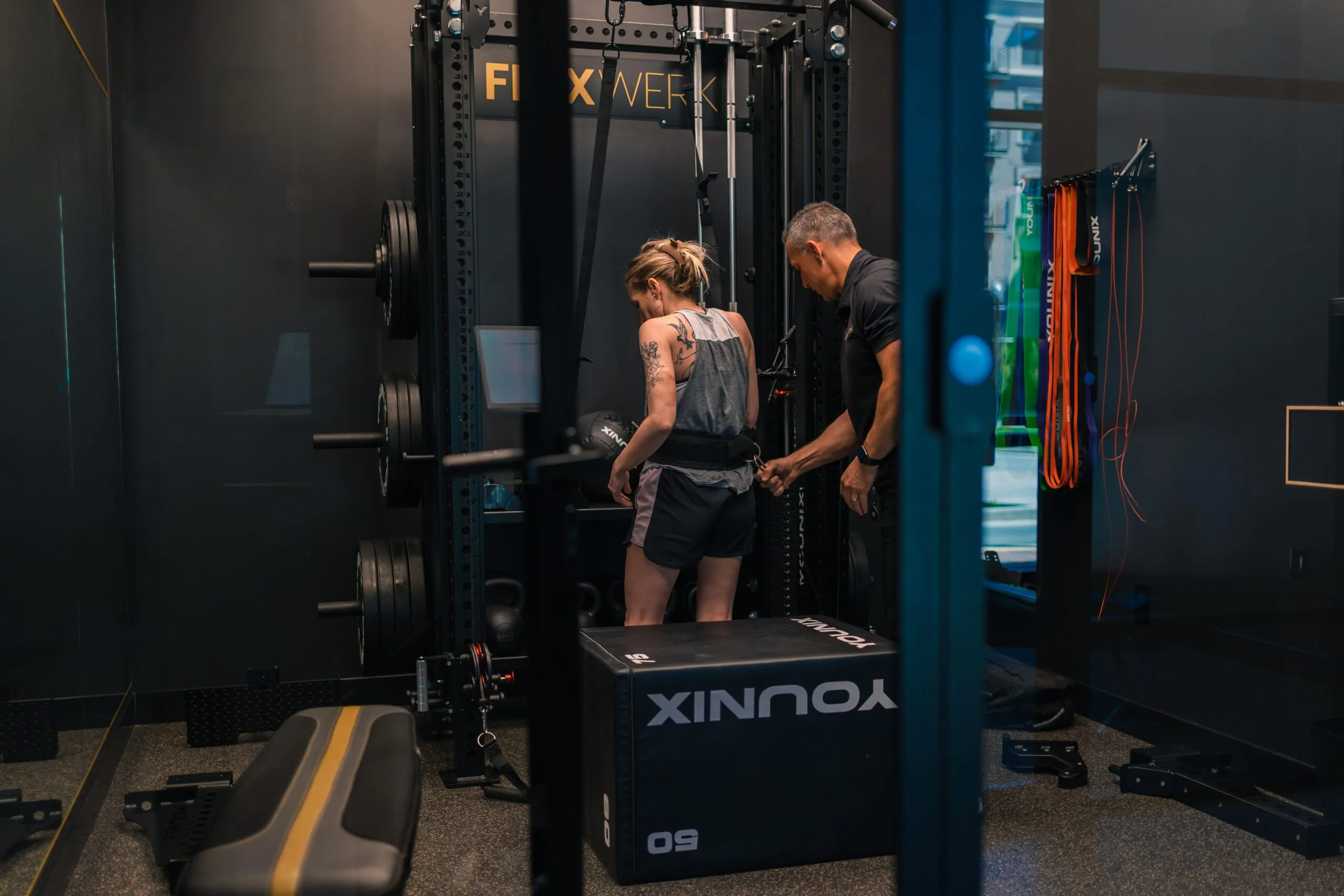
The most important training fact for a woman over 50 is also the least advertised: muscle and bone respond to progressive strength training at every age — and lifting, coached properly, is the closest thing to a longevity intervention the fitness world has. Not spin classes, not another walking program. Weights, progressed patiently, two or so hours a week — which is exactly what a growing number of Carmel women in their 50s, 60s, and beyond are quietly doing behind FlexWerk’s suite doors.
Why the priority flips at 50
Through your thirties and forties, exercise choices are mostly about preference. After 50, physiology starts voting. Age-related muscle loss picks up pace, and for women, the years around menopause commonly bring accelerated declines in bone density — the two changes that, decades later, decide whether a slip on the ice is an anecdote or a turning point. Cardio, for all its heart-health virtues, does little to reverse either. What does is well-documented and unglamorous: resistance training. Load a muscle progressively and it rebuilds; load a skeleton (safely, gradually) and bone is stimulated to adapt.
To be clear about scope: if you have diagnosed osteoporosis, heart conditions, joint replacements, or medication questions, that conversation belongs with your physician first — and a good coach will insist on it, then build your program inside whatever guidance your doctor gives. Coaching complements medical care; it never replaces it.
“Toned, not bulky” — settling this permanently
The fear that keeps women on the 5-pound dumbbells forever deserves a straight answer: building conspicuous muscle mass is hard — it takes years of specialized training and eating, and it does not happen to women by accident, at any age, least of all after 50. What actually happens when a woman in her fifties lifts progressively is the thing usually called “toned”: a bit more lean tissue, less fat over it, visibly more capable arms and legs. Will lifting make me bulky covers the full myth-autopsy, but the practical takeaway is this — the look and the strength you want live on the other side of weights heavy enough to matter, and “heavy enough, safely” is precisely a coach’s job description.
The same logic applies to the “light weights, high reps forever” advice often aimed at older women. It’s not dangerous; it’s just insufficient. Muscle and bone adapt to challenge that increases. A coach’s skill is progressing that challenge at the pace your joints, history, and confidence allow.
What a coached session at 50+ actually looks like
Forget the montage. A typical early session inside a FlexWerk suite runs like a patient tutorial:
- Foundations first. Sit-to-stand mechanics becoming squats; hip hinges becoming deadlifts from an elevated start; presses and rows at loads that feel almost polite. Technique is the entire curriculum for a while — load comes later, and it comes gradually.
- Balance and carrying built in. Loaded carries, single-leg work, getting up from the floor — the strength that maps directly onto daily life and fall resilience.
- Measured, not guessed. FlexWerk starts everyone with an InBody body-composition scan, so your progress shows up as muscle gained and fat lost on a re-test — numbers the bathroom scale is famously blind to.
Conditioning has a private-room answer too: FlexWerk’s cardio suites — HYDROW rowers, CLMBR climbers, curved treadmills — offer joint-friendly options your coach can fold in around the strength work, in the same closed-door format.
And the strength work happens in private. Each FlexSpace is a fully equipped room — rack, cables, dumbbells, your music, your lighting — with a door. No gym floor, no audience for your learning curve, no twenty-somethings to navigate around. For many women this is the whole unlock: the barrier was never capability; it was the environment big-box gyms force you to learn in.
A coach who has done this before, with women like you
Through FlexConnect, FlexWerk matches you to a coach based on goals, schedule, personality, and specialties — and “women 50+,” “post-menopause strength,” or “returning after decades off” are exactly the kinds of specialties to name in that conversation. More than 40 independent trainers run their businesses at the Carmel City Center facility, so matching has a real pool to draw from. If a match doesn’t fit, you get rematched — chemistry matters more at this stage of life, not less, and the right coach fit is worth being picky about.
Logistics respect real lives too: weekday hours 5 AM–9 PM, weekends 7 AM–4 PM, garage parking a short walk from the door, no membership ever — your coach’s booking covers the suite, and guest access is free for clients. That last detail has a lovely consequence at this stage of life: a walking partner can become a lifting partner, and plenty of women bring a friend into sessions precisely because a shared Tuesday is harder to cancel than a solo one.
Starting is free, and the baseline alone is worth the trip
The on-ramp asks nothing of you: a free consultation — an unhurried conversation about your goals and history, plus a free InBody scan that gives you an honest baseline of muscle and body fat — followed by a free first session with your matched coach. Bring your physician’s guidance if you have conditions in play; a good program starts from it.
The women already doing this in Carmel aren’t a different species. They just decided the second half gets the strong version of them — and started with one free conversation.
Related questions
Is lifting safe for a woman my age?
For most women, appropriately coached strength training is not only safe but one of the most protective things you can do — though any medical questions, including bone-density concerns or medications, belong with your physician before you start.
I've heard I should stick to walking and light weights. True?
Walking is wonderful, but muscle and bone respond to progressive challenge — weights that gradually increase. 'Light forever' leaves the biggest benefits on the table, which is exactly what a coach is for: progressing you safely.
Do I have to do this in front of people?
Not at FlexWerk — every session happens in a private suite with just you and your coach. Many women over 50 say the privacy is what finally made starting possible.